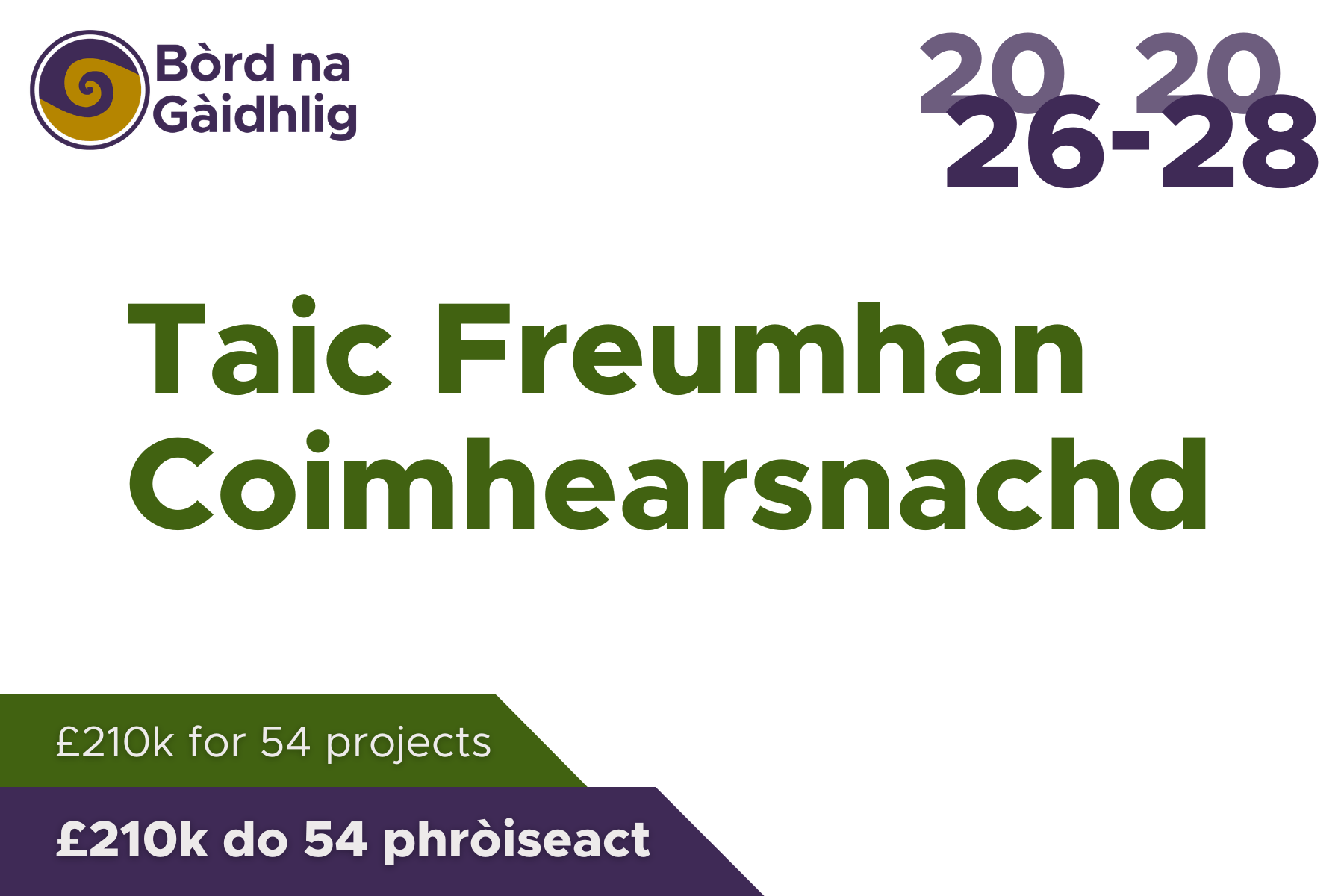
Over £200k to Support Gaelic Projects in Communities across Scotland

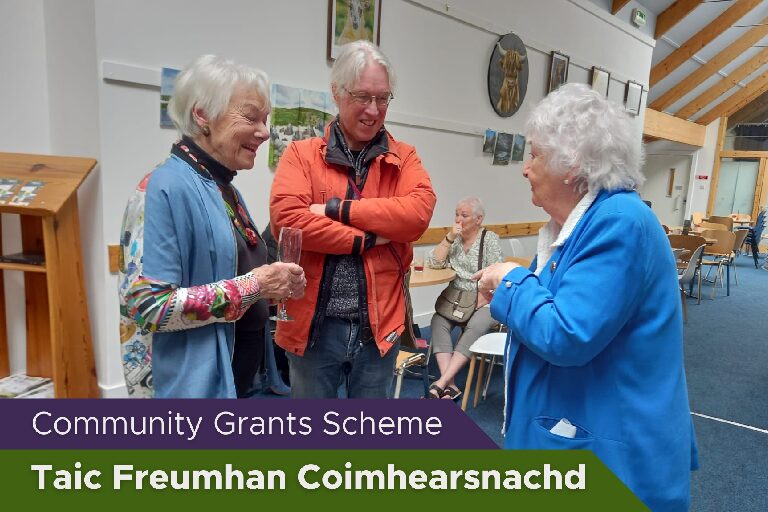
Bòrd na Gàidhlig has committed up to £210,000 to 53 Gaelic projects that will run between 2026 and 2028. This has been done through the Taic Freumhan Coimhearsnachd (Community Grants) funding scheme, Bòrd na Gàidhlig’s primary fund for supporting projects to promote and increase the usage and learning of Gaelic at community level in Scotland.

Funding has been approved for projects across Scotland and a wide range of community groups, schools, Gaelic centres and other groups will be supported. For the first time, the scheme was also opened to independent individuals as well as organisations with the aim of removing barriers to community-lead Gaelic development. Bòrd na gàidhlig hopes that this will encourage people of all ages across the country to speak and learn Gaelic and provide much needed support to Gaelic communities.

As well as the 53 projects to be supported through this year’s round of funding, there are an additional 32 receiving continued support that was granted in 2025. These groups are still building on the work they’ve been doing in regions across the country to encourage people to speak and learn Gaelic and will carry that work forward over the coming year.

Artsplay Highland is the group receiving the largest grant, £10,000 over two years. The funding will be used to develop their Ceòl is Cèilidh (Music and Ceilidh) project, which will support young children and families to speak Gaelic together more often. This will be done through the delivery of Gaelic classes and family ceilidhs in nurseries and primary schools and the creation of digital resources. Artsplay Highland hope that at least 125 children and families will benefit from the project and will be encouraged to use more Gaelic together at home.

Back Historical Society will be the recipient of the biggest grant made to an organisation based in the Western Isles. The group will receive £7,000 for their Muinntir a’ Bhac (the People of Back) project, which has been running since 2024 with support through that year’s round of Community Grants funding. The group organises community events and opportunities for people of all ages in the local community to speak Gaelic together. The plan is to expand this events programme and to add to their existing digital archive, which can be used to learn about the history of the area and to hear the local Gaelic dialect.

12 groups have been granted between £5,000 and £10,000 to deliver a range of projects. Among these are Cultarlann Inbhir Nis, who’ll receive £5,000 for the continuation of their Gaelic Cafe Cafe Cabadaich, and Bothan Dhùn Èideann, who plan to use their £8,000 grant to organise monthly concerts and Gaelic nights in Edinburgh over the next two yeas.

There are groups who will receive smaller grants too, ranging from £800 – £5,000. This includes Portree High School, the Lochaber Fèis, Stornoway Primary School, and the Trotternish Centre. While the nature and scope of these projects vary, they all share an aim of encouraging and increasing Gaelic use in their communities.

Màiri MacInnes, Chair, Bòrd na Gàidhlig, said:

Gaelic being used every day in communities is a priority focus for us at Bòrd na Gàidhlig, as well as being at the heart of the National Gaelic Language Plan 2023-28. Bòrd na Gàidhlig aims to support the efforts of people and organisations in our communities to create new opportunities for people to use and learn Gaelic in the way that best suits their specific community.

The Taic Freumhan Coimhearsnachd (Community Grants) scheme is an important way in which we give this support and I’m very much looking forward to seeing the impact of the work the successful applicants will carry out over the next two years.”

Steven Kellow, Funding and Projects Manager, Bòrd na Gàidhlig, said:

“It’s been very encouraging to see such a big interest in creating opportunities for Gaelic to be spoken and learned in communities across the country. It’s great that so many groups and individuals have come to us with new and exciting ideas and we look forward to working with them over the next two years to bring those ideas to fruition.”

More information about the TFC funding scheme can be found here.

Bòrd na Gàidhlig run a range of funding schemes at different times throughout the year. If you have a project you would like to deliver and you would like to speak to Bòrd na Gàidhlig about funding opportunities, please email tabhartas@gaidhlig.scot.


Funding Recipients by Local Authority

Aberdeen

Independent Individual: Aberdeen Sradagan (extracurricular activities group) – £4,000


Argyll and Bute

Arrochar Gaelic Language and Culture Society: Gaelic Culture in the Community – £3,000

Comann nam Pàrant Cowal: Tugainn! – £4,000

Comunn Gàidhealach Mhuile (mull Mòd Club): Further Gaelic Sharing in the Community through young People – £2,400

Independent Individual: Gaelic Development in Central Argyll – £3,300


Dumfries and Galloway

Gàidhlig Dumgal: Gaelic Learning for Adults – £8,000


East Dunbartonshire

Bishopbriggs Gaelic Group: Gaelic Learning Opportunities for Adults – £7,000


Edinburgh

Bothan Dhùn Èideann: Bothan 2026-28 – £8,500

Ionad Gàidhlig Dhùn Èidean: Community Sessions – £2,500

Parkside Primary School: Parkside Music Project – £1,750


Glasgow

Gàidhlig san Dachaigh (South Glasgow): Gaelic Classes for Adults – £5,000

Maryhill Burgh Halls Trust: Bruidhinn ar Cànan: Everyday Gaelic in Maryhill – £3,500


Highland

Acharacle Community Company: Cupan agus Cabadaich (tea and a chat) – £4,000

Artsplay Highland: Ceòl agus Cèilidh (music and Ceilidh) – £10,000

ATLAS Arts: Isle of Skye Schools Song Books – £4,000

Brora Heritage Centre / Clyne Heritage Society: (Re)Connecting our Gaelic Heritage – £8,000

Columba 1400: Gaelic Classes – £5,500

Comann nam Pàrant Portree: Sradagan (extracurricular activities group)- £4,000

Cultarlann Inbhir Nis: Gaelic Cafe (3) – £5,000

Eadarainn (Dingwall Gaelic Choir): Gaelic Development Project – £1,750

Fèis na h-Òige: Friday Club – £3,625

Independent Individual: Gaelic in East Sutherland – £4,500

Independent Individual: Singing Together (Breakish) – £1,000

Kilmuir & Staffin Cluster: Gaelic in the Community – £4,100

Kinlochewe Village Hall: Speaking Gaelic – £3,000

Lochaber Fèis: Lochaber Fèis Sports – £2,200

Lochaber Gaelic Choir: Labhair – £1,750

Portree high School: Gaelic Trip on the isle of Skye – £800

Strathnairn Development Company: Gaelic Heritage in Strathnairn – £7,500

The Trotternish Centre: The Trotternish Centre and Dublin Gaelic Circle – £3,000

Ullapool high School: Nova Scotia Trip – £4,000


Inverclyde

Inverclyde Gaelic Learners Group: Gaelic Learning opportunities for Adults – £2,000


North Lanarkshire

Greenfaulds High School: A Trip to Flodigarry – £8,000


Perth and Kinross

The Growspace Network: Dàimh na Tìre: Gaelic Heritage, Community, and the Future of the Land – £4,000

Live Music Now Scotland: Perth Tea and Tunes – £3,000


Renfrewshire

West Primary Shool: Gaelic at West Primary School – £3,000


The Scottish Borders

Independent Individual: Gaelic in the Scottish Borders – £3,000


South Ayrshire

Friends of the Broadway Prestwick: The Broadway Cinema Phase One – £2,000


Stirling

Làmhan: Fèis Calasraid – £4,000


Western Isles

Back Historical Society: Voices of the People of Back (2) – £7,000

Bragar and Arnol Community Trust: Gaelic at Grinneabhat – £4,000

Caraidean Uibhist SCIO: Caraidean (friends) – £2,500

Carloway Estate Trust: Youth Immersion Trip – £2,200

Fèis Taigh Dhonnchaidh: Our Voices from Ness – £4,750

Lionel School: Lionel Schools Songs – £2,000

Ness Historical Society: young Historians – £1,295

Stornoway Primary School: P7 Trip to Edinburgh – £2,000

Uist Council of Voluntary Organisations (UCVO): Tea, Cake, and Conversation – £3,000


National

Independent Individual: Play in a Day – £2,500

Lingo Flamingo: Bidh Seana-ghuth a’ Roinn na h-Aoise – £6,500

Open Book: Gaelic Project – £7,700


International

Independent Individual: A-nunn ‘s Anall – £2,000

Independent Individual: Music of the Gaels – £3,500
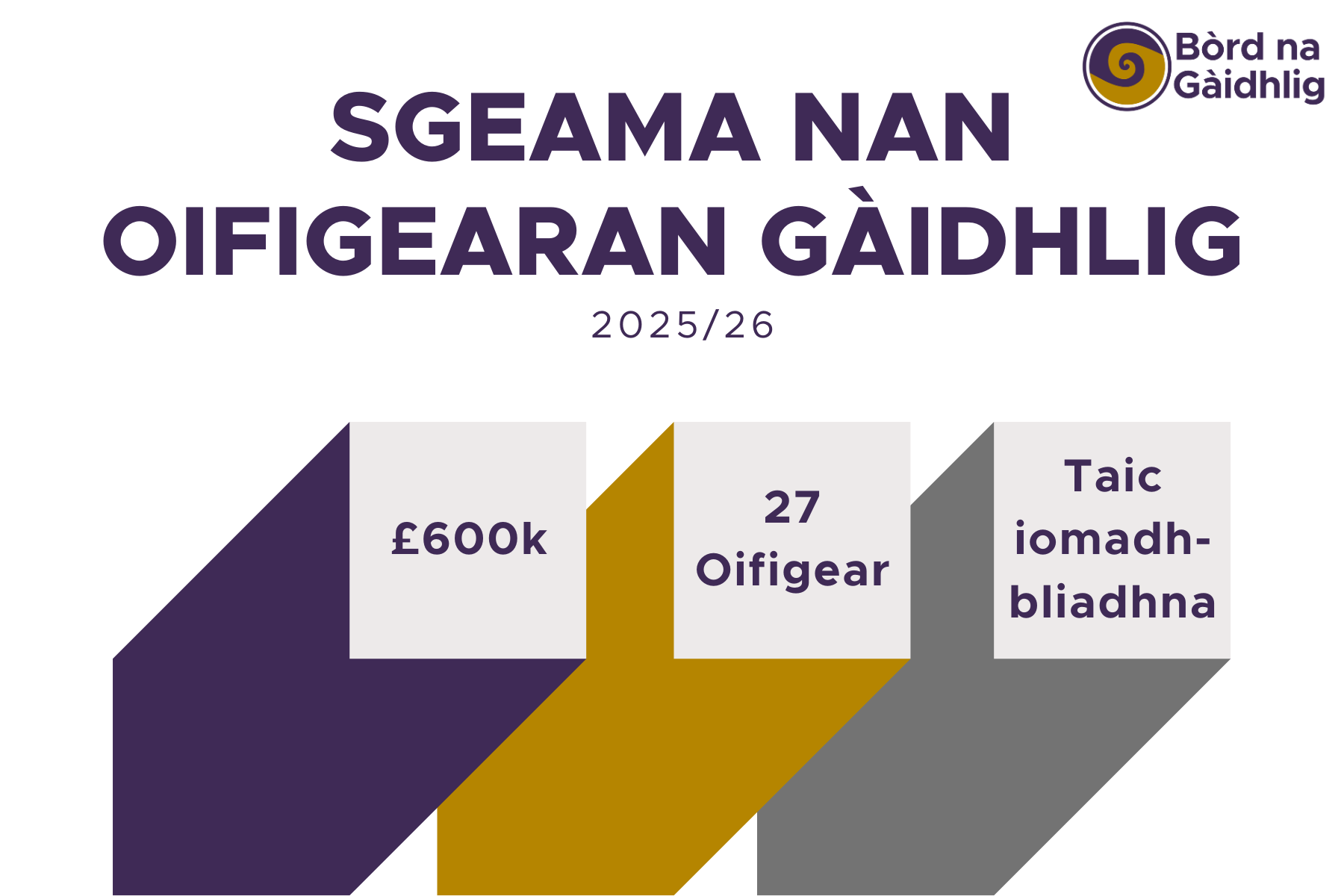
Gaelic Officers Scheme Invests in Communities

Bòrd na Gàidhlig has announced the allocation of funding for Gaelic Officers through a new round of the Gaelic Officers Scheme. The Scheme is funded in partnership by the Scottish Government and Bòrd na Gàidhlig and will support 27 posts across a range of organisations as they undertake Gaelic development work in communities across Scotland. Several groups will now benefit from multi-year support from the scheme for the first time.

The latest round of funding was opened in May and closed to new applications in June. A range of changes were made to the previous scheme, including further support and professional development for Gaelic officers. Bord na Gàidhlig received 44 applications from a wide range of charities, with a mix of previously-supported organisations and new bodies seeking support.

Successful applicants to the scheme had to meet a range of criteria and outline how they would deliver against the key priorities set out by Bòrd na Gàidhlig, including supporting the everyday use of Gaelic in communities, supporting Gaelic centres and events, developing community Gaelic language plans and supporting partnership working across organisations delivering Gaelic services.

Ian MacMillan, Director of Development at Bòrd na Gàidhlig, said:

“Bòrd na Gàidhlig is delighted that officers funded through this scheme will now be working to make a positive impact on Gaelic in their communities. These officers will make a clear and visible difference through their activity and engagement. We are looking forward to seeing an increase in partnership working as we enable organisations to build connections to deliver across our communities.”

Depute First Minister Kate Forbes said:

“This £600,000 investment in the Gaelic Officer initiative aims to help Gaelic to thrive in traditional areas like the Western Isles and Skye. Gaelic Officers enrich communities and support activities which bring economic benefits to Scotland.

To support Gaelic’s growth, our Scottish Languages Bill will strengthen the rights of parents to ask for a Gaelic school to be established in their area and introduce targets on the number of people speaking Gaelic.”

You can find more information about Bòrd na Gàidhlig’s Gaelic Officers Scheme here.

Bòrd na Gàidhlig runs a number of funding schemes at various times throughout the year. If like to speak to Bòrd na Gàidhlig about funding opportunities for organisations and projects, please email tabhartas@gaidhlig.scot.

Community Grants Scheme 2025-27

Bòrd na Gàidhlig has announced and re-opened its Taic Freumhan Coimhearsnachd (Community Grants) Scheme, offering extended funding opportunities to Gaelic projects in communities. Support is available for projects for up to two years, and for the first time support is being provided to projects between Gaelic and Irish speakers through this scheme as part of the Colmcille initiative.

Support of up to £10,000 (£5,000 per year) is available to community groups and organisations running projects which support:

  • Gaelic events in your community and online
  • Projects and opportunities that encourage young people to use Gaelic together
  • Projects that support Gaelic usage among families and between generations
  • Adult Gaelic learning in the community
  • Colmcille – Building connections between speakers of Gaelic and Irish

The fund is expected to be competitive this year, with a total estimated budget of £100,000 per year (subject to confirmation of BnG’s 2025/26 budget).

To learn more about the Taic Freumhan Coimhearsnachd grant scheme and its expanded funding opportunities, please visit the Taic Freumhan Coimhearsnachd information page or contact us at tabhartas@gaidhlig.scot.

You can also find information on our other funding schemes on our website.

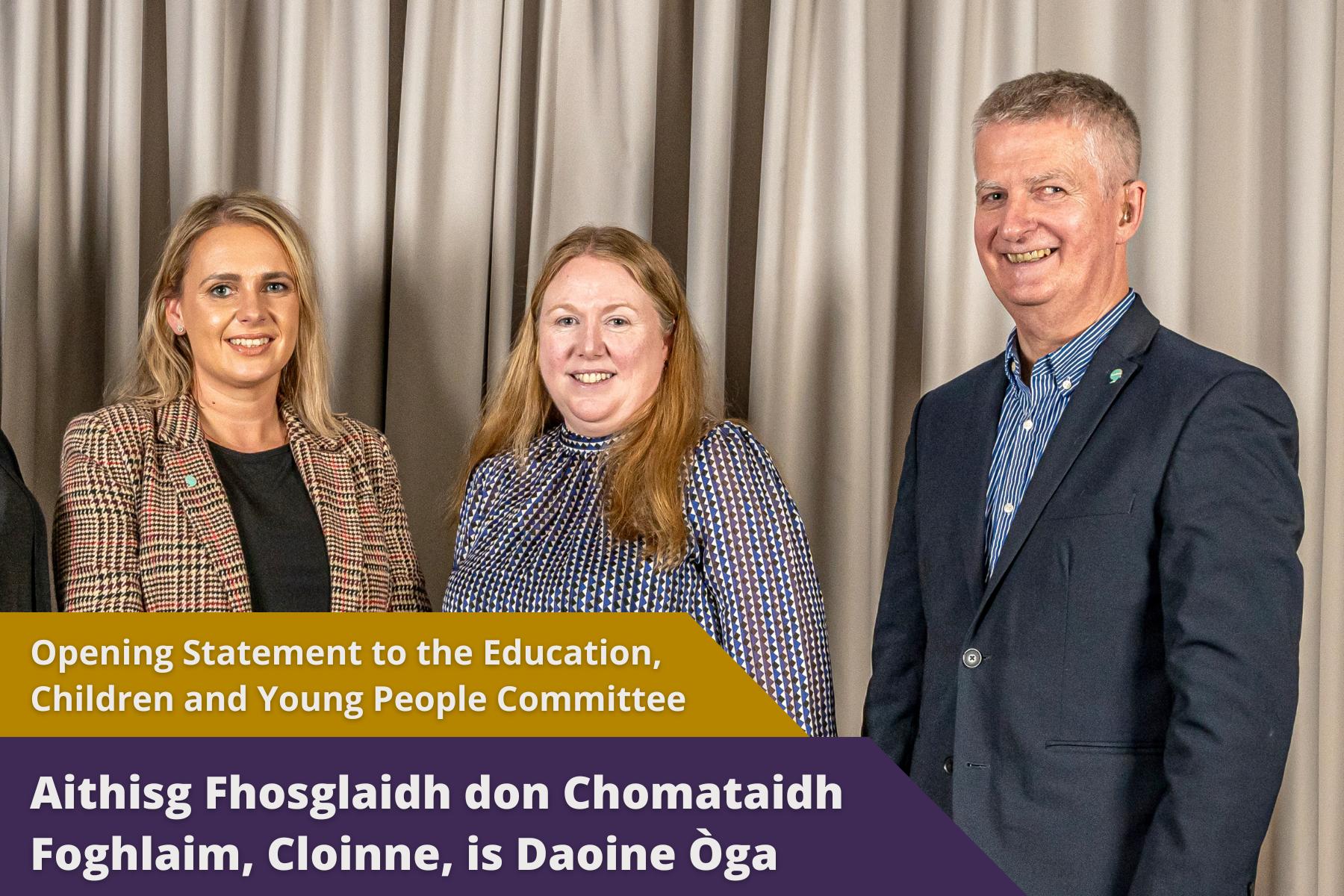
Opening Statement to the Education, Children, and Young People Committee

Bòrd na Gàidhlig’s Senior Management Team gave evidence to the Education, Children, and Young People Committee this morning as they discussed the Scottish Languages Bill. Ealasaid MacDonald, Bòrd na Gàidhlig’s Ceannard (CEO), gave the opening statement and said:

“This is an important time for Gaelic, and decisions we take today will have a real impact on the future of our language. And by our language, I mean Scotland’s language. Bòrd na Gàidhlig welcome this Bill, a step forward in the legislative journey of Gaelic, and would strongly resist any suggestion that it should not proceed.

“For those of us attending the reception of 50 years of Sabhal Mor Ostaig on Thursday evening, the mood of celebration was aided by the news that the new Cabinet will include a Gaelic speaker who will have responsibility for the language. Literally someone who speaks and understands  our language. We wish Ms Forbes well in her role and look forward to working with her.

“This will hopefully change the approach to Gaelic within the Government and see Gaelic considered across portfolios, where it can be a part of the solution, and allow a joined up policy approach. This would go a long way to strengthening the language.

“And, this Bill is part of the work in strengthening the language at a policy level. Key elements of the Bill, including the changes to the functions of Bòrd na Gàidhlig and standards for plans, will move us forward to ensuring the systems we have in place serve the language. And it is crucial that the education elements of the Bill, are enacted. Clarity is required on the central aspect, areas of linguistic significance, and the work of the commitee will be crucial in ascertaining this.

“However, this legislation will not solve the issues that we face at the community development level, which require a new and transparent investment model to deliver on the targets in the  new National Gaelic Language Plan.

“I must reference our submission to the Financial Memorandum of the Bill, where we underline the importance of a financial model being a core element of the success of this legislation. As we state in our submission, “In order to achieve its potential impact it must be supported across Government with fair and equitable funding and commensurate with the statutory responsibilities of Bòrd na Gàidhlig.”

“Gaelic is more than a language. For many, myself included, it is a way of life, at the core of my being linked to my culture, heritage and aspirations for my family and my community. For Scotland, it is a key element of the society in which we live, our historical past and a key driver in our future.  It is a social, economic and cultural asset. One that cannot be replaced . This legislation is a step forward.  it won’t provide all the solutions we need, and a priority must be to address the inadequate funding model, but it will be a key tenet on moving the provisions for Gaelic forward.”

The meeting was recorded and can be viewed on the Scottish Parliament’s website.

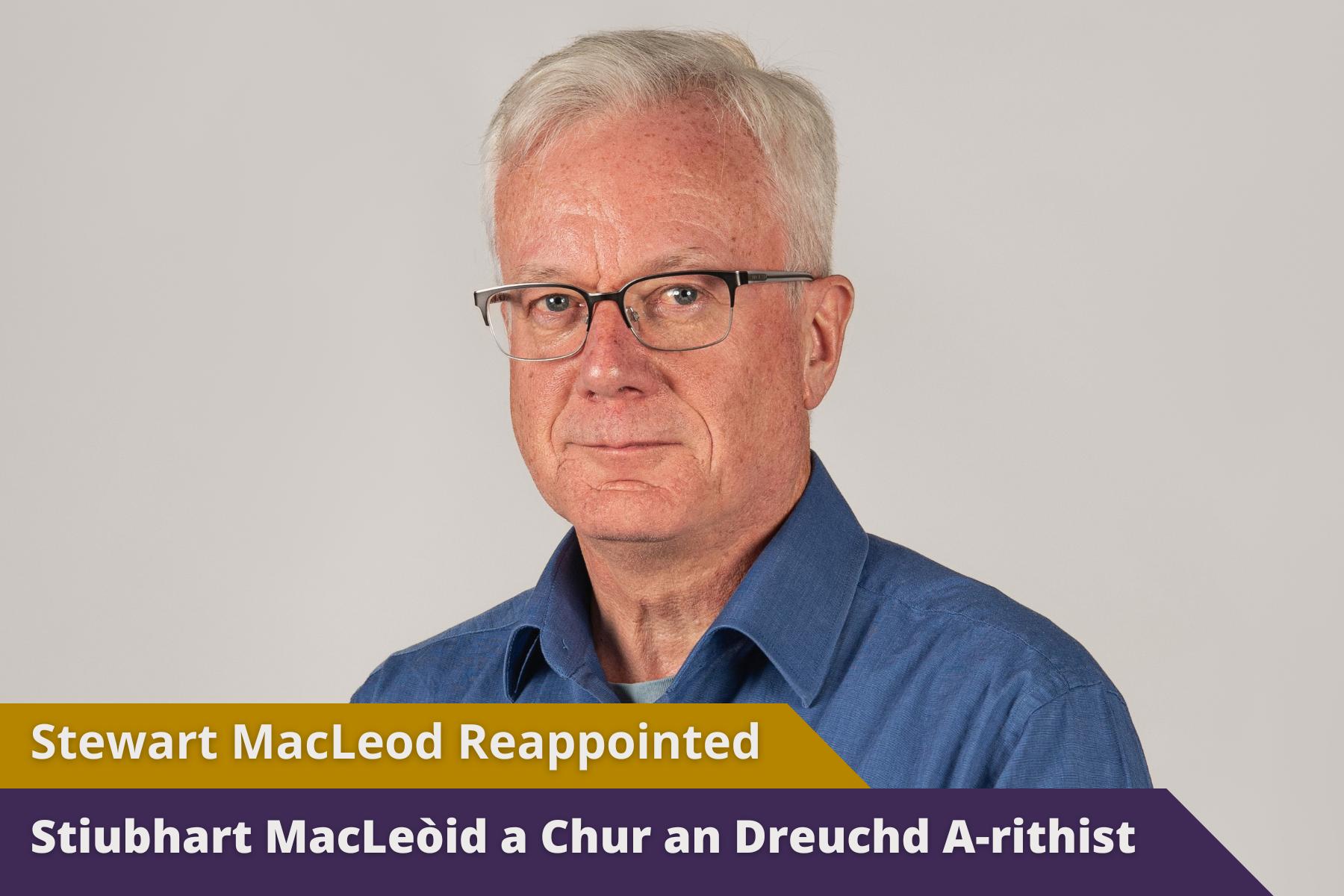
Stewart MacLeod Reappointed to BnG Board

Bòrd na Gàidhlig welcomes the news that the Cabinet Secretary for Education and Skills, Ms Gilruth, today announced the reappointment of Stewart MacLeod as a Member of Bòrd na Gàidhlig.

Stewart MacLeod is a member of the Chartered Institute of Public Finance and Accountancy (CIPFA), and brings finance and accounting knowledge and experience to the role of Chair of the Audit and Assurance Committee. He has been involved in Gaelic-related activities and organisations over many years, and is interested in the promotion and maintenance of the language amongst learners and the traditional communities.

This reappointment will be for four years and will run from 16 March 2024 to 15 March 2028.

More information about Stewarts reappointment is available the the Scottish Government’s website.

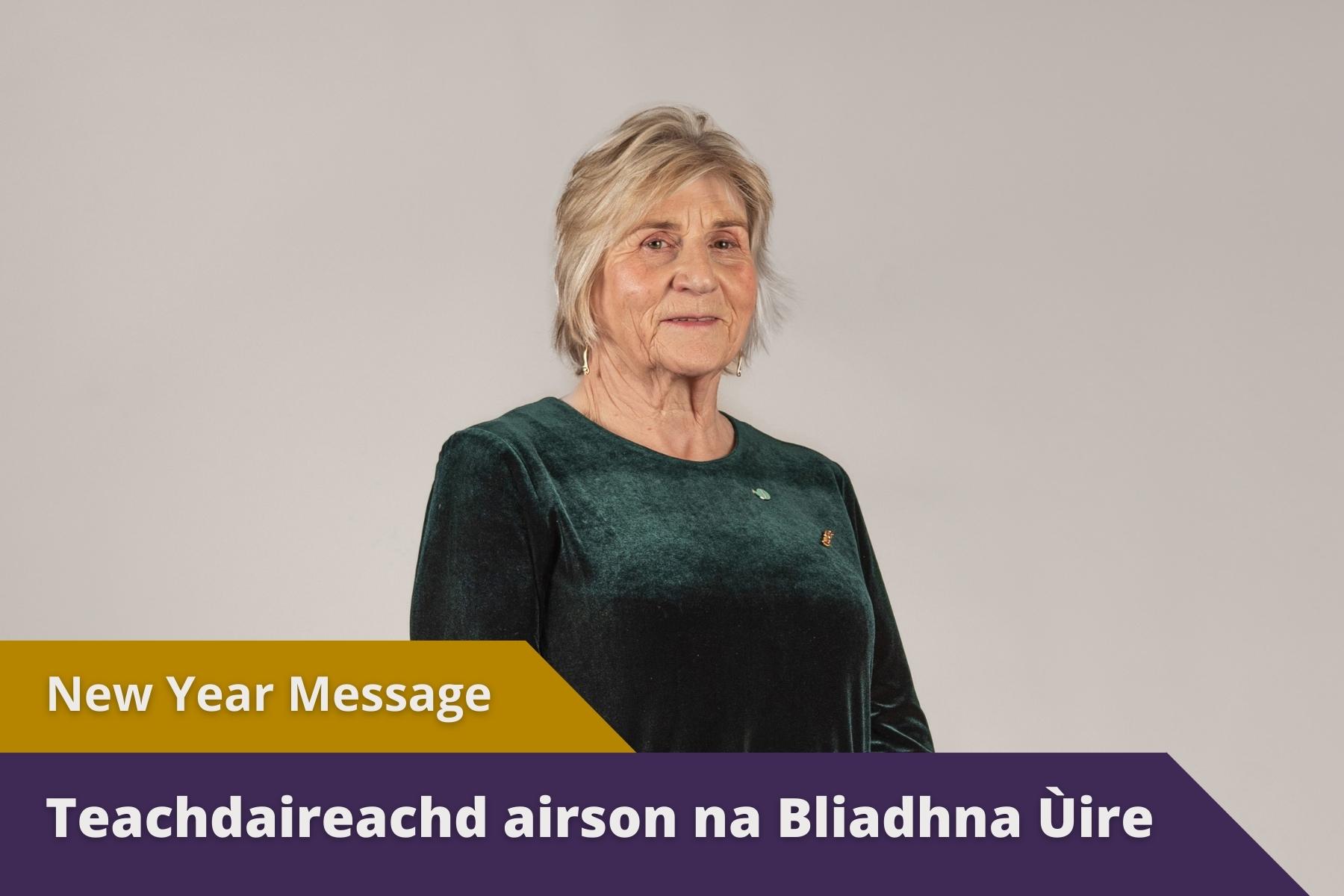
New Year message of collaboration from Chair of Bòrd na Gàidhlig

A New Year with a new National Plan for Gaelic is an opportunity to achieve results through collaboration, according to the Chair of Bòrd na Gàidhlig. Speaking as she welcomed the New Year and the commencement of the next National Plan, 2023–28, which was finalised at the end of 2023, Mairi MacInnes said:

“Looking ahead to what will be a very important time for Gaelic, I am delighted that the National Plan will allow us to work together to achieve progress in the promotion and development of the Gaelic language. At its heart is a measurable increase in the numbers of people speaking, learning, using and supporting Gaelic.

“Bòrd na Gàidhlig will now produce a Corporate Plan which will identify how the aims and targets in the identified priority areas of the National Plan will be achieved. Success will only be realised through working together and this National Plan will bring together authorities, organisations, and communities, indeed, everyone who has an interest in ensuring that Gaelic thrives across Scotland, and beyond.

“I also urge everyone to engage with the process of the Scottish Languages Bill, which will make its way through the Scottish Parliament this year. Legislation is an important foundation for the development and security of the language and this is an opportunity to enhance Gaelic’s status in law.”

You can read more about the new National Gaelic Language Plan here.

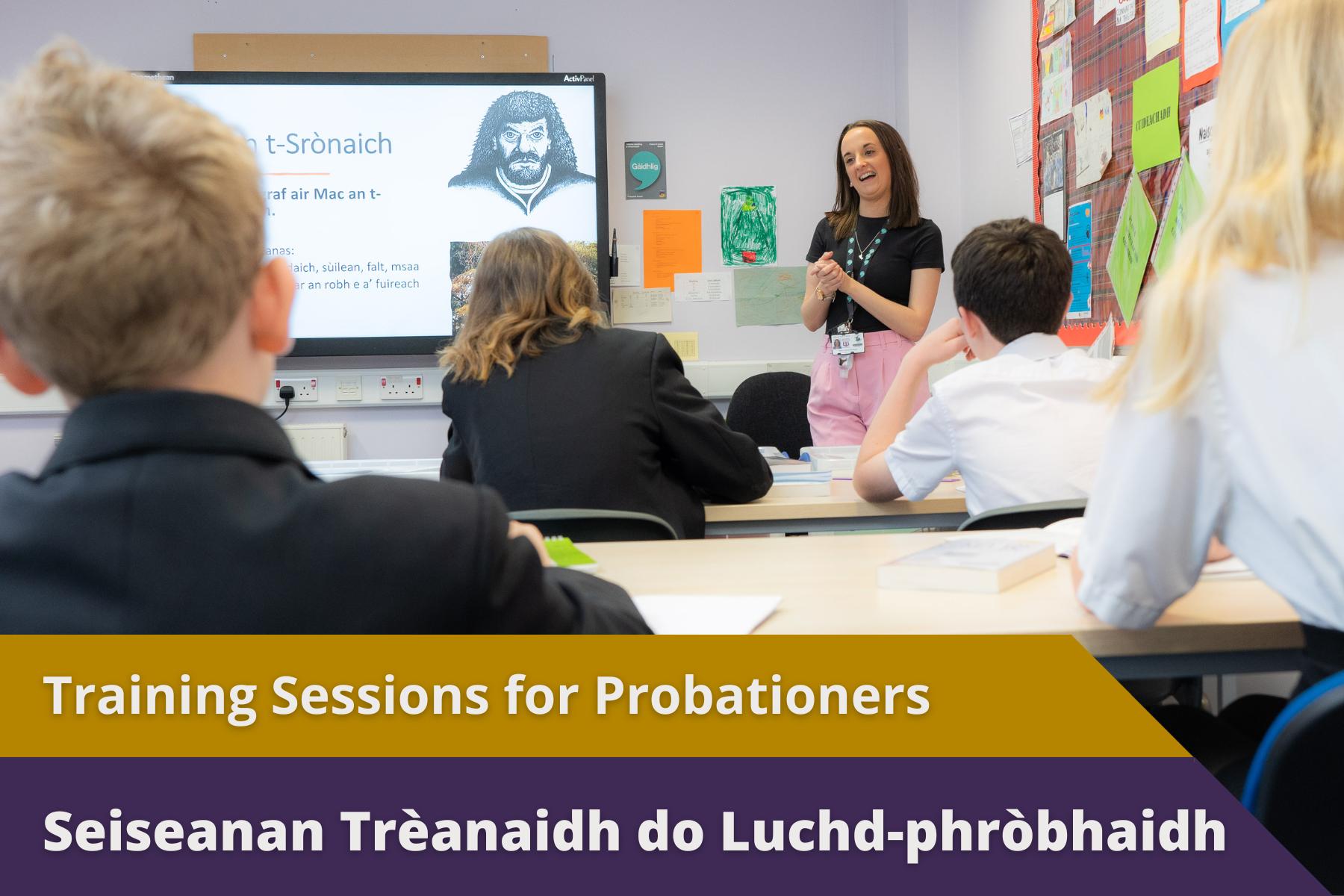
Training sessions for Probation Teachers!

Bòrd na Gàidhlig are running training sessions for Gaelic probationers this year!

There will be 4 sessions in this series, the first of which will will run on Wednesday, 06.12.23 from 4:15pm to 5:15pm on Microsoft Teams.

We are going to be focusing on Education Scotland and are very happy that Maeve MacKinnon will be joining us to talk about the resources available to teachers.

You are most welcome to join us to talk and listen and it will be a great opportunity for probationers to network with other new teachers accross Scotland.

If you would like to join us for the session, please book your place on Eventbrite. Dont miss out – there are only 25 spaces!

The dates for the three remaining sessions are still to be confirmed, but they will each have a diffrent focus and will be looking at;

  • Other Gaelic Resources
  • Immersion Pedagogy
  • An Introduction to Gaelic Organisations who Support Schools and Education

If you would like more information, you can contact Sian Baldwin, Development Officer (Teachers), at sian@gaidhlig.scot.

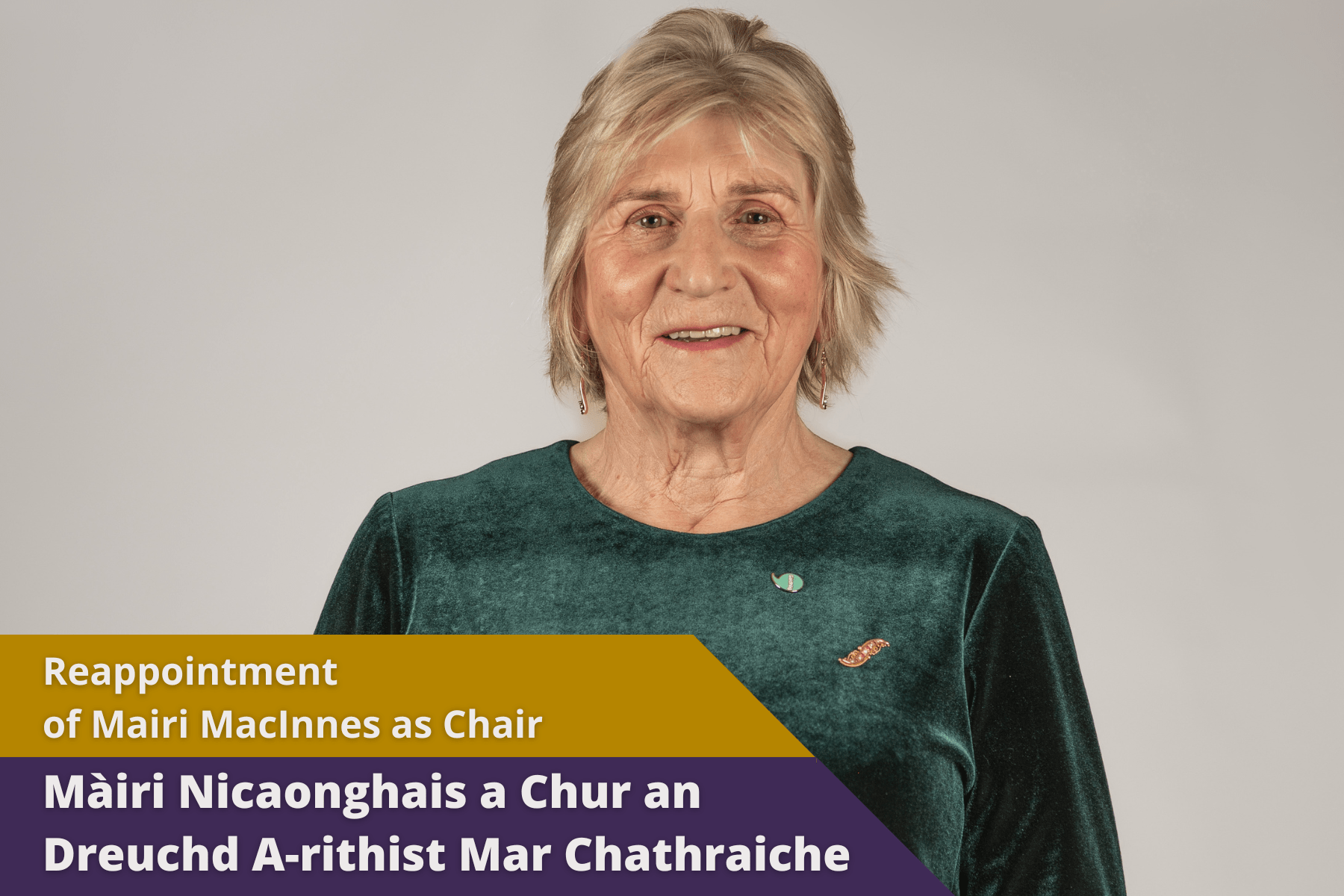
Reappointment of Mairi MacInnes as Chair

The Cabinet Secretary for Education and Skills, Ms Gilruth, yesterday announced the reappointment of Mairi MacInnes as Chair of Bòrd na Gàidhlig.

Chair

Mairi MacInnes has over time held numerous leadership roles within her local community relating to Gaelic language & culture, education and community development: spanning early years, primary and adult learning.  Mairi, former head teacher of Sgoil an Iochdair, was also a member of the 1+2 Approach to Language Learning Group in the Western Isles.  Mairi is Chair of Cnoc Soiller Ltd, and a founder board member of Ceòlas Uibhist, the highly acclaimed Gaelic arts organisation. She has also sat on the board of a number of national organisations, such as the Scottish Arts Council and Comataidh Craolaidh Gàidhlig. Mairi lives in South Uist.

Mairi MacInnes has been the Chair of Bòrd na Gàidhlig since 16 March 2020.

Reappointment

This reappointment will be for two years and will run from 16 March 2024 to 15 March 2026.

This reappointment is regulated by the Ethical Standards Commissioner

4 New Members Appointed to Bòrd na Gàidhlig Board

The Cabinet Secretary for Education and Skills, Ms Gilruth, today announced the appointment of Robert Dunbar, John MacDonald, Michelle Macleod and Donald MacPhee as Members of the Bòrd na Gàidhlig.

Mairi McInnes, Chair, Bòrd na Gàidhlig said:

“We’re delighted to welcome the new board members at Bòrd na Gàidhlig. The four new members bring such a wealth of knowledge and experience across a wide range of fields and this will be more will be more important and beneficial than ever while Bòrd na Gàidhlig looks forward to a new National Gaelic Language Plan and the introduction of the Scottish Languages Bill.”

Members

Robert Dunbar has been Professor of Celtic at the University of Edinburgh since June 2013. He is one of the foremost experts in the world on law and policy for linguistic minorities. He is an expert of the Council of Europe in relation to minority language issues, and since February 2023, he has been a member of the Committee of Experts of the European Charter for Regional or Minority Languages, a Council of Europe treaty. He has also worked with the Venice Commission of the Council of Europe in relation to language law and language policy. He has frequently advised governments, language policy bodies and NGOs on language legislation for minority language, including the Welsh Academy in relation to the Welsh Language (Wales) Measure 2011. Robert holds a PhD in Celtic from the University of Edinburgh, on the life and secular poetry of John MacLean (1787-1848), the Tiree and Nova Scotia Gaelic poet, as well as an LL.M from the London School of Economics, an LL.B from Osgoode Hall Law School, Toronto, and a BA from the University of Toronto.


John MacDonald is a native Gaelic speaker, originally from South Uist, who lives in Edinburgh. Having obtained a business degree, he worked in the IT industry in his early career and then spent over 30 years of his working life in the Scottish voluntary and community sector before retiring in 2022. His roles ranged from Development Officer to Director and Chief Executive with national charities. This has given him insight into effective community development, sage stewardship of public funds and good governance. He has served on the board of trustees for a number of voluntary organisations over the years and is currently a volunteer adviser for Citizens Advice in Edinburgh as well as running online conversation classes for Gaelic learners.


Michelle Macleod, originally from the Isle of Lewis, is a Professor of Gaelic at the University of Aberdeen. Michelle has taught Gaelic and related subjects in universities in Scotland and Ireland for more than 25 years; she has also taught applied sociolinguistic courses and has supervised PhDs in language planning. She has held various leadership roles for languages in higher education including in 2022 being one of three Future of Languages Research Fellows funded by the Arts and Humanities Research Council where her work considered how research could support the policy ambitions for the UK’s indigenous languages; she also currently sits on the British Academy/University Council for Languages Strategic Committee for Languages in Higher Education. Michelle has conducted research into Gaelic literature, theatre, second language acquisition and community language planning. Her community language planning research was inspired by the three years she spent as Project Officer and then the first Director at Ionad Chaluim Chille ìle and she recently collaborated with Comunn na Gàidhlig and Sabhal Mòr Ostaig on the Bòrd’s project to establish a network for Gaelic language officers. She is currently Chair of Theatre Gu Leòr and the Catherine McCaig Trust.


Donald Kenneth (DK) MacPhee is a fluent Gaelic speaker who was born and brought up in a strong Gaelic speaking community in South Uist where his late father John was a Gaelic teacher for 40 years. DK’s values, knowledge and skills were further developed over nine years in Catholic seminaries, three of those in Valladolid, Spain. In 1983, this time teaching English in Spain as part of his degree at the University of Glasgow, an unexpected diagnosis of cervical dystonia/spasmodic torticollis literally changed the direction of his life. After graduating with MA (Hons) Hispanic Studies in 1985, and then from Napier College (now University), Edinburgh in 1986 with a Postgraduate Diploma in European Marketing and Languages, his working life began at a charity that supported the unemployed into work. Promoting skills and learning for all, especially for the most excluded and disadvantaged, was to become a central theme of his working life. Voluntary work, including the establishment of the first self-help group for people with dystonia in Scotland and then his appointment as the first Dystonia UK officer outside London, also continued throughout those years.

After two decades of development roles across charities and public sector agencies, in 2009 DK became the lead strategic policy and development officer for Gaelic corporate planning and development within Glasgow City Council with responsibility for all aspects of the council’s Gaelic Language Plans. The expansion of Gaelic Medium Education and the implementation of the Gaelic Plan are also commitments in Glasgow City Council’s 2022-2027 Strategic Plan. Some family members also work in, or have children in, Gaelic Medium Education. DK has a special interest in sport, in particular football, and has contributed to Gaelic radio and television programmes views on football, dystonia and other general interest stories for decades. A BBC ALBA documentary about his life with dystonia called Dystonia: Beatha air Fhiaradh / Life at an Angle won a Gaelic Award in 2021. He is also one of the many Gaelic voices of Duolingo and has been a Board member of Comunn na Gàidhlig since 2018 and of FC Sonas since 2022.

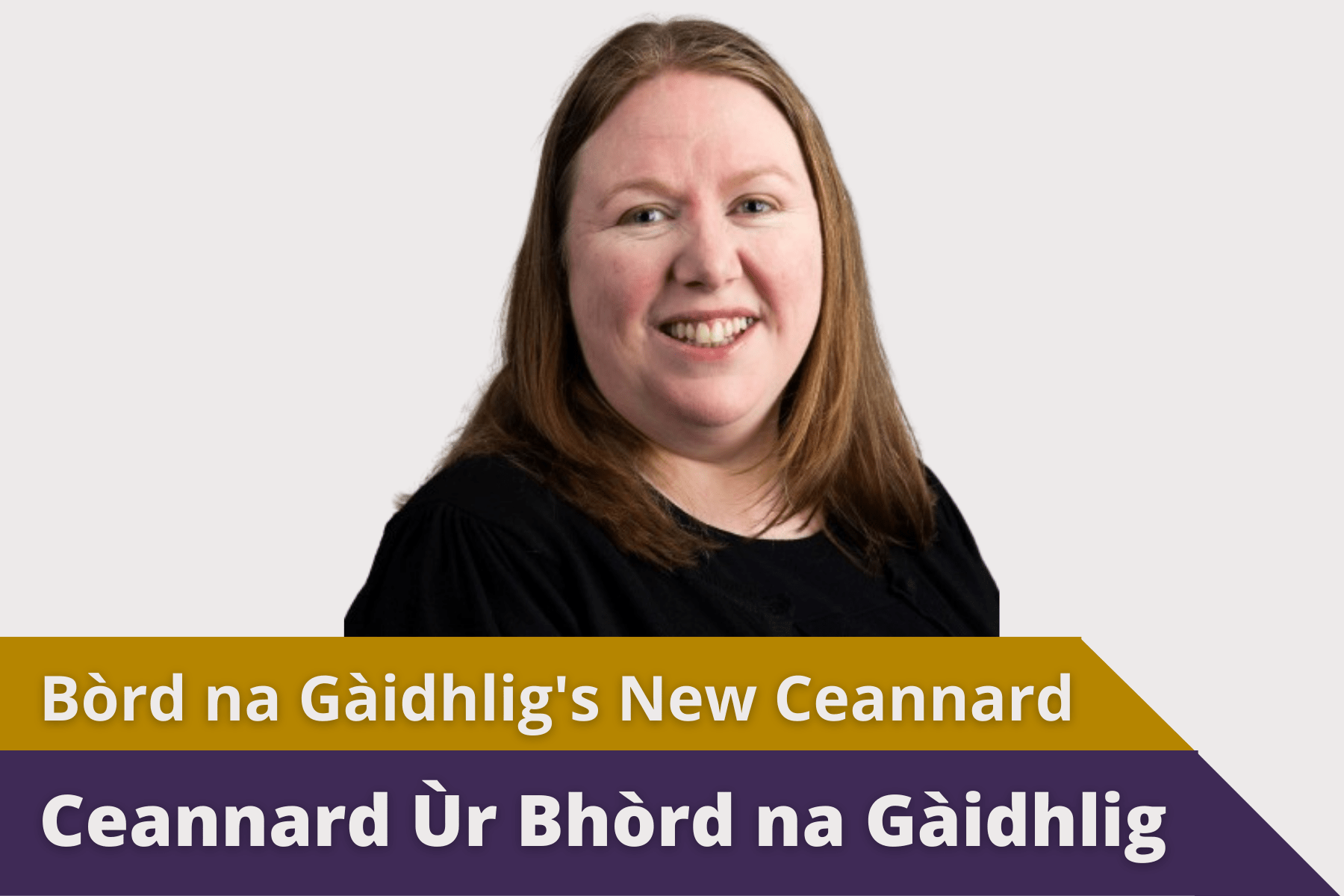
New Ceannard of Bòrd na Gàidhlig Appointed

Bòrd na Gàidhlig today announced the appointment of Ealasaid MacDonald as its new Ceannard (CEO) who will take up the post in September 2023.

Ealasaid, hailing from the Western Isles and with her home in Stornoway has extensive experience of working in both mainland and island settings.  In her current role as Director of Strategy and External Affairs with MG ALBA she leads on corporate and stakeholder communications. With experience of working in the public sector and as a freelance policy and public affairs consultant, Ealasaid has been at the forefront of many initiatives and developments to promote the needs of Gaelic speakers throughout her career.

Based in Stornoway, Ealasaid will lead Bòrd na Gàidhlig through forthcoming developments, working closely with Board members and the senior management team, and also with Scottish Government, public bodies and Gaelic communities.

Màiri MacInnes, Chair of Bòrd na Gàidhlig, said: “We are delighted to welcome Ealasaid to this important role, at an exciting time for the progress of the Gaelic language with a new National Gaelic Language Plan and a new Scottish Languages Bill. She has a background working with key public bodies and with a particular focus on corporate policy initiatives. With her experience of working in this sector, Bòrd na Gàidhlig will benefit from the skills she has acquired in management and development issues related to the Gaelic language and culture.”

Ealasaid said, “I am very pleased to be taking on this important role at a crucial time for Gaelic. I look forward to working with our communities, Gaelic organisations and wider partners to develop the Gaelic language across Scotland and beyond. Working in partnership is a reason for success as we look towards the new National Plan for Gaelic, it is more important than ever.”

Education Secretary Jenny Gilruth said: “I would like to welcome the appointment of Ealasaid MacDonald as the next CEO at Bòrd na Gàidhlig and congratulate her on a successful application for this important ministerial appointment.”

“The Scottish Government is looking forward to working closely with Ealasaid and the team at Bòrd na Gàidhlig in supporting and promoting Gaelic across Scotland as we prepare to take forward our Scottish Languages Bill.”

x  Powerful Protection for WordPress, from Shield Security
This Site Is Protected By
Shield Security